What’s That Necklace Mean?

il_fullxfull.736964617_ddiq

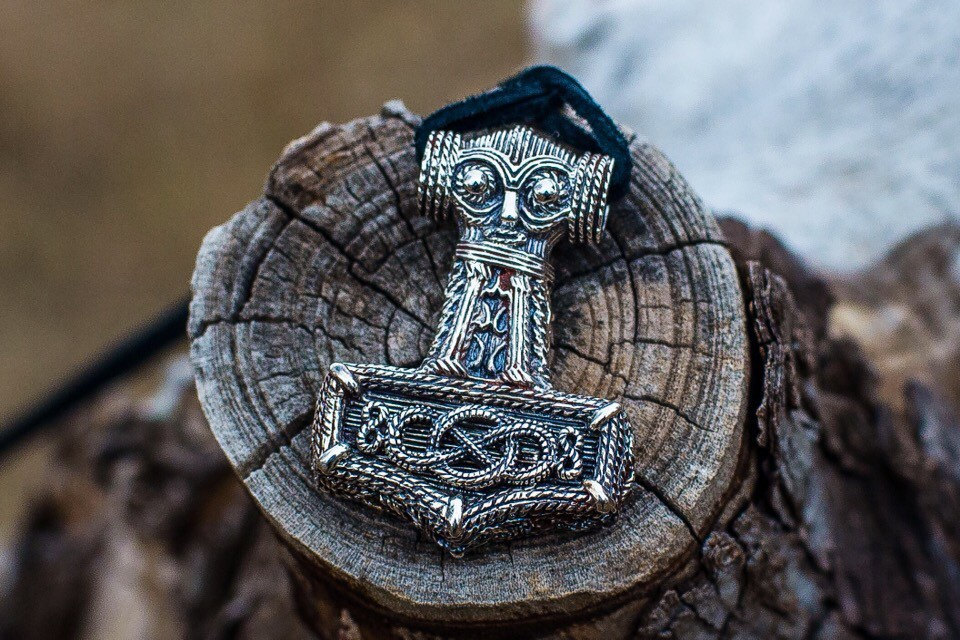
Photo taken from one of Etsy’s many Mjolnir Slingers

“What’s that necklace mean?” Someone says to you, after noticing your hammer pendant. You may have been asked this before? If you haven’t yet, get ready, because you certainly will. Do you have an answer ready? Because when you are put on the spot like that you have two choices. The first is to evade the question and mumble something about your love of Norse Mythology (I have done this, sadly) or the better response: honestly explain you’re Heathen.

This is easier said than done. To most of the world Heathen is a term either used colloquially scorn the non-religious (Godless Heathens) or its so steeped in hero worship it makes people nervous (think vikingtru). Expect the person asking about your Mjolnir to have no idea about any of this and simply explain you wear it as a reminder of your faith. Just say you’re Heathen.

It’s not your job to evangelize or to give a history lesson. Just say what you are. Say it as matter of factly as possible, with confidence and maybe a gentle smile. If questions continue and they want to know what you mean by that – keep it simple. I would explain that Heathenry is about honoring our ancestors and bettering our community and ourselves. There is no reason to even mention your Kindred, book collection or TV shows with battle axes.

Just say what you are.

Date Night

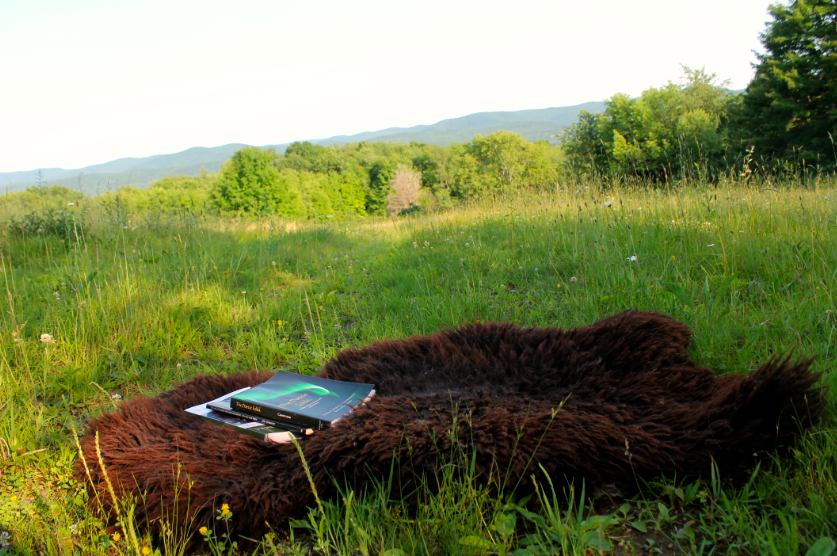
Screen Shot 2015-07-03 at 7.59.48 PMHeathen gals are a breed apart. We’re a strong-minded and  stubborn sort but every once in a while we lighten up when we find a guy that will treat us right. In my case: I let a tall, dark, and handsome English fellow take me out to dinner this week. We had a picnic on a mountainside sharing our meals together and then I read out loud to him from the Edda. The sunset was gorgeous, the grass was soft, the bugs were barely biting, and I even remembered to pocket a little bit of drink into my flask for an after-dinner nip. A perfect date night for a woman with a hammer on her neckline…
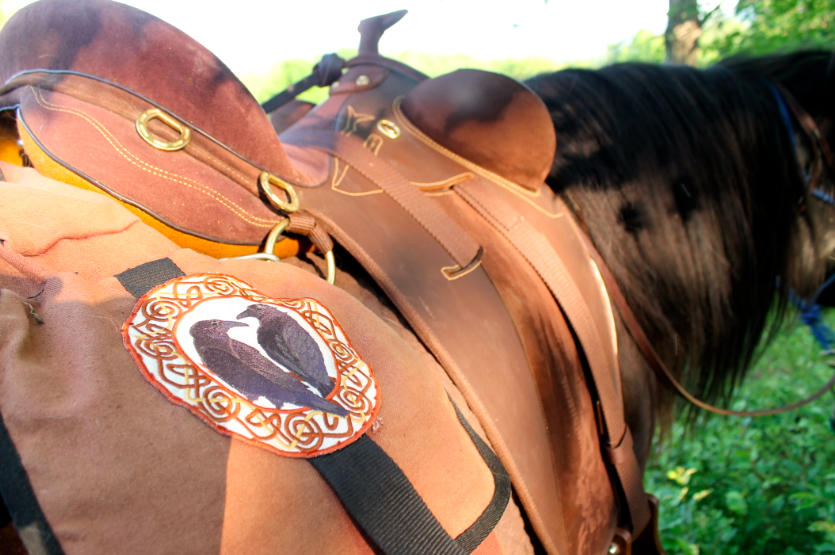
What you see here in this image is a black sheep fleece and some reading.  This was carried on the back of my very handsome date: a 20 year old Fell Pony named Merlin. He was the gentleman who literally carried me off to dinner on the mountain. This photo was taken at the hillside where I tied him off on a small apple tree to graze while I ate, read, and took in the lore that creates the flavor of the faith. Between the Edda, the view, and the fine horse nibbling on green summer grasses I was beyond content.

Screen Shot 2015-07-03 at 8.00.15 PM

Starting Your Studies. Chewing slowly.

There is so to read and if you’re just starting your studies it can be daunting. Not because the information isn’t out there, but because a lot of this reading isn’t easily digested in big chunks the way chapters of a novel are. Maybe you’ve got the right brain acids to read ancient lore and scholarly works and absorb it as easily as Krispy Kreme but for me….

I need to chew slowly. Let’s take Eric Wodening’s We Are Our Deeds as an example.

I’ll admit that I had to read Wodening slowly, making notes and taking it a paragraph at a time. That book was the best introductions to Heathen thought I could begin with, but the style of writing required me to chew and swallow slowly. I ask you, what’s wrong with that? Taking on Heathen studies means reading work few people seek outside of Academia. It’s better to sit down and focus on a little at a time and truly grasp it than fly through a jumble of words so you can add it to your “Yes I read that” pile. That pile is worthless if nothing took root in your mind. Remember, Odin took his own eye for a little wisdom. All I’m suggesting is reading slower.

That is the best advice I can give: read the best work available and read it as slowly as you need to. Haven’t studied anything for a while? Then get a notebook and your book of choice and set them down on the same table with a good pencil. If it helps, go to your local library to be surrounded by wisdom and lore and quiet. Open your book to the first chapter and write the name of that chapter in your notebook on a clean page. As you slowly read, stop every paragraph or two and write down the important points or meaning of what you are reading. For example, if I was starting off with my study of We Are Our Deeds I would begin with notes like this based on the first two pages of his work in Chapter 1.

Chapter 1: Good and Evil Innangard and Utangard

– The words good, evil, right, and wrong are often taken for granted.

– good appears in every Germanic Language in some form.

– Proto-Germanic godanaz and ghedh – meaning “to unite, to join, to fit”

– Original meaning might be “that which is suitable to society”

– Good is what keeps us part of our tribe, clan, society and out of the wilds

– Tribe, family, clan is “inside” or Innangard (old Icelandic term)

– Outside negative influence, dangerous wights, threats are Utangard (also O.I.)

Summary – Ancestors saw good and bad differently than modern people. It had to do with what kept you and your tribe at their best and safe. It had to do with community and selflessness.

And that is just the first two pages! If that is all your brain can take in one sitting, then digest it and stop studying for a day. Let all that knowledge cook a while. Meditate on it while walking in a park, forest, or on your porch. Leave a small offering on your path as a thank you to the Gods for the ability to find, read, and digest such words. While on that quiet walk, consider what you thought of as “good” before? Does this change how you feel about something you were once told was not good like sex before marriage? What does that have to do with keeping you outside a community and separated from it? How does sex between two consenting adults endanger your tribe? What did our ancestors think of premarital sex? Write down that thought in your notebook to bring up at your next Heathen gathering or to research in the future.

Do you see how just two pages of a book on Heathen Ethics can send you into a personal mental hopscotch game of jumping over a lifetime of prior conditioning?! It’s okay to read three pages a day. It’s okay to read one paragraph a day. What matters is truly understanding it and learning to think as Heathens do. And this type of study is so important. This is a religion that comes with homework. There is no Sunday School or Asatru 101 course someone will hold your hand through. You need to do the work, period.

When we share our personal studies at Gatherings of TGH it is more valuable to bring up one point you focused and thought hard on from an obscure page of a book by a valued author than to slap a generic printing of the Edda in front of the fire and say “I read this! All of this!” Surely there is pride in showing your enthuisum and effort – but gatherings and study groups are not places to boast over libraries – they are the places to share wisdom in frith without gouging each others eyes out.

Keep reading, read slow as you need to, and write notes. Take the time to think about what you read. Wisdom doesn’t come from a stack of books you checked off a list. Wisdom comes from challenging and questioning your own mind. Study does this the same way lifting weights or running miles challenges the body. And Darling, it’s time to start working out. You’re a Heathen now.

In Your Service,

Corbie
The New Girl

This is the journal of woman new to the Heathen faith and finding her home in it. Here you will read about my explorations of Heathen ethics, thew, lore and news – as well as the story of my study group, Tyr’s Good Hand. I’ll do my best to share what it is like to be a new member of this community and hopefully encourage other beginners to learn, connect, and share their own stories and ideas. So how about I introduce myself?

Corbie is the name I go by, a nickname from the SCA. Corbie is Scottish slang for crow. Long before I knew who Huginn and Muninn were – I was drawn to those dark birds. Whenever I saw crows or ravens in pairs I considered it good luck and good luck never hurts. I’m an archery marshal in that organization and my love of archery is one of the reasons I find myself a modern Heathen. It’s one of the many “old world” activities I adore. I’m also an avid hunter, falconer, homesteader, spinner, martial artist, trail rider and horse cart driver. These are the things I love to do—that I feel the most authentic version of myself doing—and I do them often. While there are plenty of Heathens out there with zero interest in medieval reenactment or assorted activities – I’m not one of them. I love living my real life doing the things I used to only read about in Tolkien novels. I promise you I still have a solid head on my shoulders. No one who raises and butchers pigs on a regular basis is too much of a fruitcake. I don’t wear capes. I don’t have a wand. I refuse to wield a foam sword. I want to learn to use a real one, though.

If it sounds like I’m retired at 32, all I can say is NOPE. I’m not wealthy, far from it. I quit my corporate gig as a graphic designer to be a full time writer and farmer on 7 acres in upstate New York. I am barely scraping by – but I consider scraping by doing what you love in a place you love a successful life. My farm is my life, my pride, and my boasting. It’s as much a part of my practice as blot and study. You’ll hear a lot about it. You have been warned.

Thank you for reading along on this journey. I don’t claim to be any sort of expert, and the opinions here are my own. I don’t speak for the folk of Tyr’s Good Hand or Heathenry at large – only myself. This will be a very personal collection of growth, change, community building, and becoming a better woman one day at a time.

In Your Service,
Corbie M.